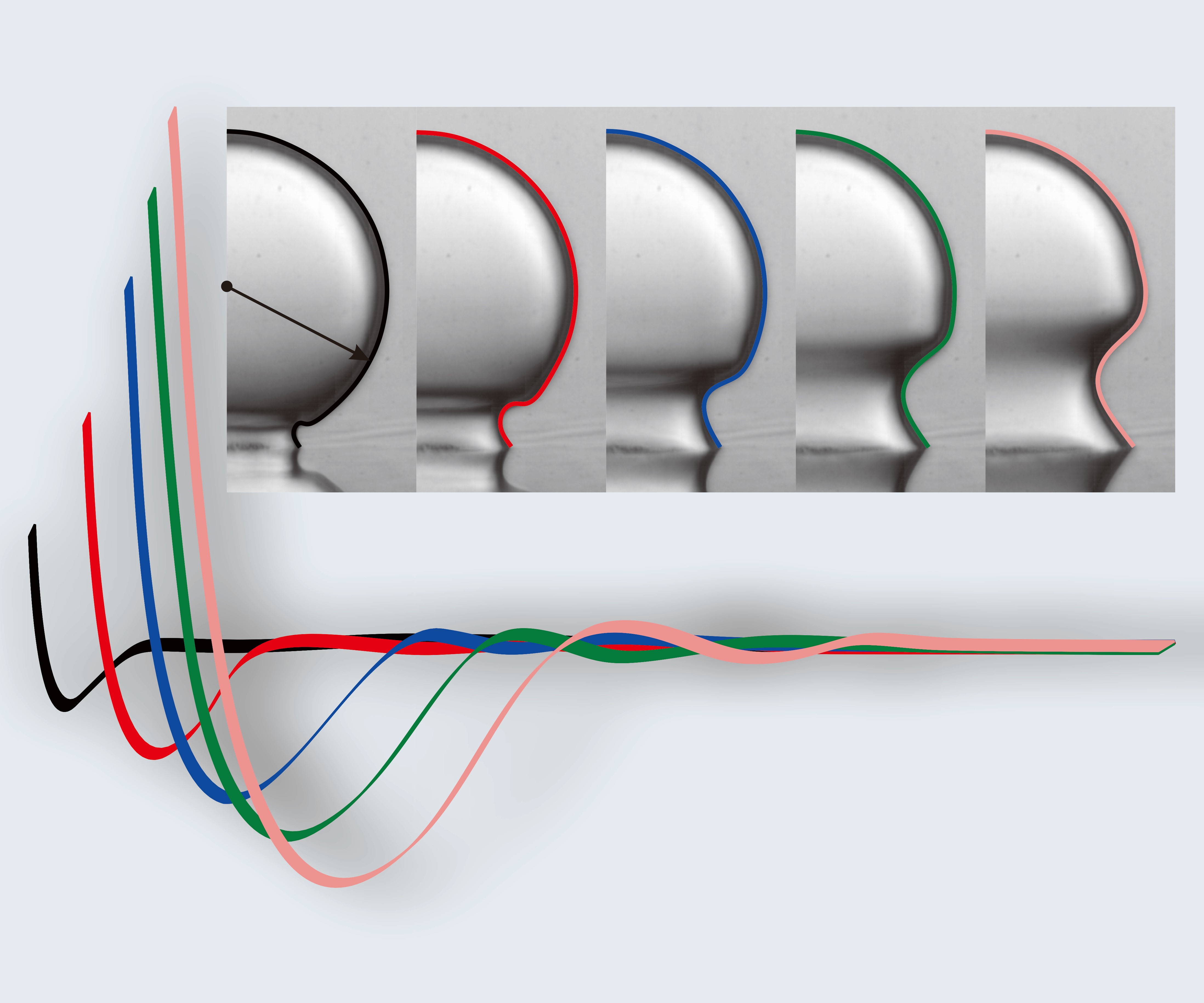
Mechanistic modeling and experimental characterization of electrowetting-driven droplet dynamics for programmable microfluidic actuation.
This research program investigates the fundamental physics of droplet dynamics under electrowetting actuation, focusing on how electrical forcing interacts with interfacial mechanics, contact-line dynamics, and viscous dissipation to control droplet motion. Electrowetting-on-dielectric (EWOD) provides a powerful platform for actively manipulating droplets in digital microfluidics, optics, and thermal management, yet many aspects of its transient dynamics remain poorly understood. My work combined high-speed experiments with theoretical modeling to uncover the governing mechanisms that determine droplet spreading, contact-line motion, and dynamic instabilities in electrowetting systems. Early work demonstrated that electrowetting-driven droplets exhibit a universal transition between underdamped oscillatory spreading and overdamped viscous relaxation, and established predictive scaling relations linking droplet viscosity, size, and electrical forcing to the characteristic actuation time of droplets [1,2].
A central contribution of this work is the discovery of how microscopic contact-line physics governs macroscopic droplet motion, particularly in regimes where droplets detach from surfaces. In the Physical Review Letters study, we showed that contact-line pinning plays a hidden but decisive role in determining the critical conditions for droplet jumping from a substrate. By combining theory and experiments, the work established a quantitative relation between surface heterogeneity, viscous dissipation, and excess surface energy generated by electrowetting actuation, revealing when a droplet will detach and convert surface energy into kinetic energy. This result connected classical wetting theory with practical droplet manipulation technologies, providing a predictive framework for applications such as microfluidics, droplet transport, and bioprinting [3].
Subsequent studies extended these insights to more complex regimes of electrowetting-driven flows. The Journal of Fluid Mechanics work established a theoretical framework describing droplet spreading dynamics when the applied voltage exceeds the contact-angle saturation limit, a regime previously thought to limit electrowetting applications. We demonstrated that although the equilibrium contact angle saturates, the initial contact-line velocity and resulting capillary-wave dynamics continue to scale with the applied voltage, enabling controlled droplet deformation and ejection [4].
Additional studies further explored phenomena including satellite droplet ejection caused by high-speed contact-line motion, and controlled droplet jumping using modulated electrowetting actuation, providing predictive models linking droplet size, viscosity, and electrical forcing to detachment behavior [5,6]. Together, these works establish a unified physical framework for electrowetting-driven droplet manipulation across regimes ranging from controlled spreading to droplet detachment and ejection.