Eludidating viscoelastic response at unprecedented time and length scale; explaining short-time dynamics of softwetting; and applying these physical principles to design and fabrication of bio-inspired self-cleaning, anti-fouling surfaces for wearable electronics
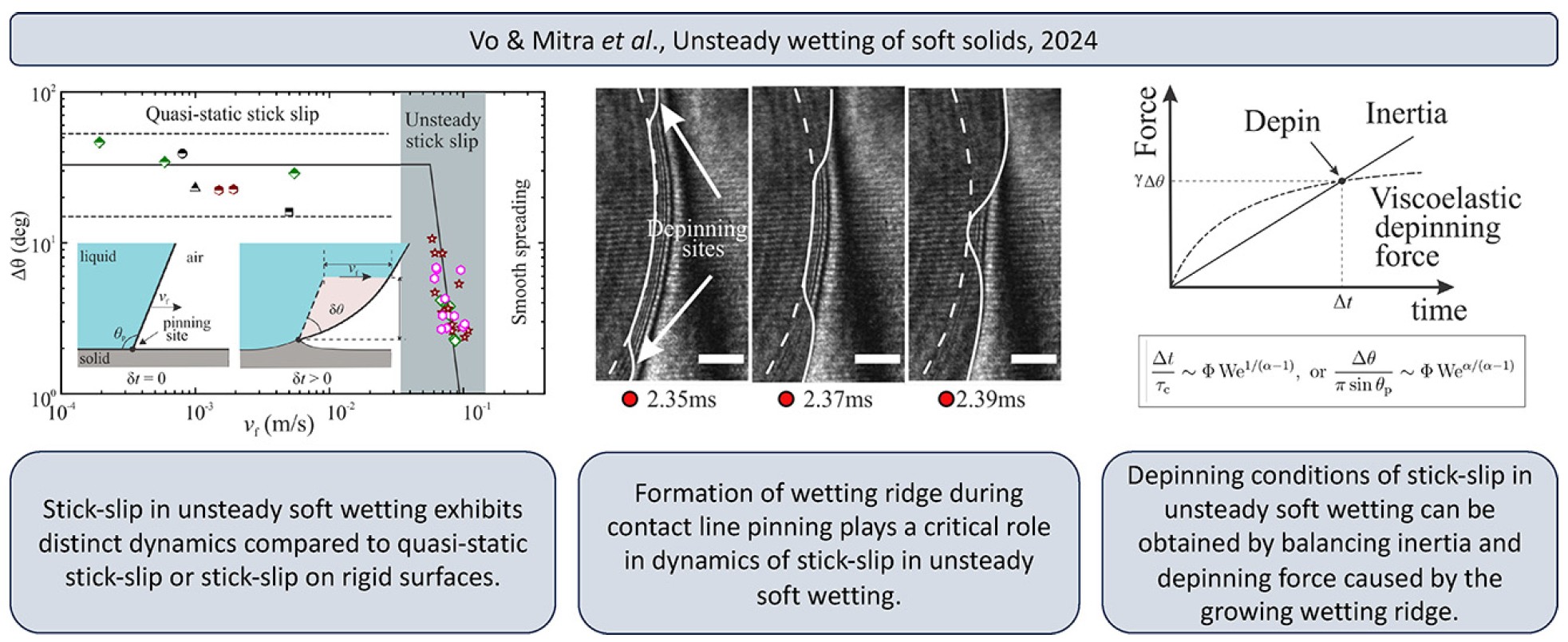
This research program investigates how soft materials respond to liquid forces across extremely short time scales, revealing how viscoelastic deformation influences dynamic wetting phenomena. Using high-speed interferometry and high-resolution imaging, we studied how soft substrates deform when interacting with rapidly spreading or impacting droplets. These experiments showed that soft solids exhibit multiple dynamical responses across different time scales, from ultrafast visco-capillary deformation to slower viscoelastic relaxation. Direct measurements of the early-stage formation of wetting ridges—the microscopic deformation created where a liquid meets a soft surface—revealed that the ridge initially grows anisotropically and is governed by competing elastic, viscous, and capillary forces. These findings provide quantitative insight into how soft materials deform under transient interfacial stresses and establish predictive frameworks for understanding soft wetting dynamics [1,2].
Building on this mechanistic understanding, we investigated how liquid droplets interact dynamically with deformable surfaces, focusing on droplet spreading and impact. Experiments demonstrated that soft substrates can significantly alter droplet impact outcomes, producing regimes of bouncing, hovering, or wetting depending on liquid viscosity, impact velocity, and substrate elasticity. By systematically mapping these behaviors using dimensionless parameters such as Weber and Ohnesorge numbers, we established quantitative criteria governing transitions between non-wetting and wetting states. Additional studies revealed how interactions between trapped air films and capillary waves determine the bouncing-to-wetting transition of droplets impacting soft materials. Together, these results highlight how substrate mechanics fundamentally modify interfacial transport processes compared to rigid surfaces [3,4].
The insights gained from these studies enabled the engineering of functional soft surfaces for sensing and biomedical applications. By tailoring microstructural features and surface chemistry, we developed bio-inspired soft materials with hierarchical textures and controlled wettability that enable robust mechanical sensing and contamination resistance [5]. For example, graphene–elastomer composite surfaces incorporating microcrack networks and hierarchical roughness exhibit ultrahigh sensitivity to mechanical vibrations while maintaining self-cleaning and water-repellent properties, enabling wearable acoustic sensors for voice recognition in noisy environments. More broadly, the fundamental understanding of soft wetting and viscoelastic surface dynamics developed in this work provides design principles for functional soft interfaces in flexible electronics, biomedical devices, and microfluidic technologies.